On Prophethood
And if you are in doubt as to what We have revealed, step by step, to Our servant, then produce a Sura like thereunto; and call your witnesses [and helpers if there are any] besides Allah, if what you say is true. ❋ But if you cannot, and of a surety you cannot, then fear the Fire whose fuel is men and stones, which is prepared for those who reject faith. (Wa in kuntum fī raybin mimmā nazzalnā ‘alā ‘abdinā fa‑’tū bi-sūratin min mithlihi wa ad‘ū shuhadā’akum min dūn Allāhi in kuntum ṣādiqīn. • Fa-in lam taf‘alū wa lan taf‘alū fa-’ttaqū al-nār allatī waqūduhā an-nās wa al-ḥijāra u‘iddat li’l-kāfirīn.)
An Introduction Verifying Prophethood
Consider this: Just as the previous verse proves the first of the four main aims of the Qur’an, and that is divine unity (al‑tawḥīd), so this one proves the second, the prophethood of Muhammad (Upon whom be blessings and peace), through the most consummate of his miracles, which was his challenging [opponents] with the Qur’an’s miraculousness and inimitability (i‘jāz).
We have set out evidences of his prophethood in detail in another book and a part of them is summarized here in six topics.
The First Matter
It may be concluded from the circumstances of the prophets, through inductive reasoning (al‑istiqrā’ al-tāmm) and the analogy known as ‘hidden’ (al‑qiyās al-khafī), [based on] the unvarying order [in similar things], that the pivot and basis of the prophets’ missions, and their dealings with their communities were found most perfectly and completely in Muhammad, Upon whom be blessings and peace, who was the master of mankind at the time of its maturity.
This furnishes the best possible argument and proof that he was also the Messenger of Allah. For through the tongues of their miracles all the prophets as though testified to Muhammad’s truthfulness (Upon whom be peace), who was a luminous proof of the Maker’s existence and unity.
The Second Matter
Consider this, that although they were not necessarily wondrous, all Muhammad’s (Upon whom be peace) conduct and actions pointed initially to his truthfulness and finally to his justice and fairness.
Do you not see how he acted in situations similar to the incident of the cave when there was no hope of aid: he declared with complete certainty, confidence, and earnestness: Grieve not; verily, Allah is with us! Thus, his conduct at the start [of his mission] – his unconcern in the face of opponents, and his lack of fear and hesitation, and complete confidence – indicates that he adhered to the truth.
Then his establishing at the end – the rules essential for attaining happiness in this world and the next – and the rightness of his actions and his adhering to the truth are all evidence for his justice and fairness.
This was true for each of his actions. But if you take a look at all he did and all his conduct there will appear before your eyes a proof of his prophethood as brilliant as lightning. So reflect on this!
The Third Matter
Understand that the past and the present – that is, the Era of Bliss [the time of the Prophet] – and the future are united in affirming his prophethood, just as his own self was evidence for it. We should now study the following four pages.
Firstly we seek blessings by studying his self, first of all by calling to mind four points:
Firstly: Even if they are of the highest standard, artificial and man‑made things can never be equal to what is natural and ‘real’ or take their place. The slips and blunders of artificiality will surely show up the imposture.
Secondly: The only thing that fixes high morals in the ground of reality is seriousness, and the only thing that perpetuates them in their totality is truthfulness (ṣidq). If truthfulness departs from their midst they become as straw winnowed by the wind.
Thirdly: Just as attraction and [mutual] inclination are present in things that are harmonious and congruent; so contradictory and opposing things give rise to repulsion and mutual disgust.
Fourthly is [the rule] “there is in the whole what is not present in the parts,” like a rope being strong though its strands are weak.
If you have grasped these points, understand now that as was acknowledged by his enemies, Muhammad’s (UWBP) works, and the course and story of his life, all testify that he had the finest character and that combined in him were all the highest moral qualities.
Such a combination is marked by personal dignity, gravity, and self‑respect, and these do not permit a person to stoop to trivial inanities. Just as the angels do not permit devils to mix with them,
so in no way when they come together do these elevated morals permit trickery and falsehood to enter amongst them. Have you not observed that someone famous only for bravery does not stoop to lying, except if forced? So how could a person in whom all [those qualities are present]?
Thus, it is established that [the Prophet’s] own person (UWBP) furnished evidence for himself as clear as the sun.
Moreover, if you study his conduct (Upon whom be peace) from the age of four till forty, you will see that although this is the period of youth when the natural passions are rampant and hidden traits and any latent slyness or trickery in a person’s character come to light, he lived these years in complete righteousness, constancy, and chastity, and in regular and orderly fashion. There was no hint of trickery in any of his conduct; not even the obdurate and clever [enemies] he was faced with [observed any wiles in him].
And then you see him when he is forty years old, when the character becomes fixed and habits ingrained, and he emerges as a marvel who brings about a mighty unprecedented revolution in the world. This could have occurred only through Allah’s [will].
The Fourth Matter
Know that the page of the past, which contains the stories of the prophets, recounted [by the Prophet] (Upon whom be peace) in the Qur’an, is a proof of his prophethood. This [page comprises] four points:
The First: If a person grasps the basic principles of a science and recognizes its essential usefulness and employs its proficiently where he should, and constructs his cause on it, this is evidence of his skill and expertise in that science.
The Second Point: If you are cognizant of human nature [you know that] you will never see a person being so bold as to oppose [the majority] without hesitation or concern or constraint, or to lie even if insignificantly, among a people even if they are few, for a cause even if lowly, with dignity even if small. So how could someone – with the utmost dignity, for a cause of the utmost gravity, among people who were extremely numerous, in the face of extreme obstinacy despite his being unlettered – how could he speak of matters unattainable by reason alone and disclose them with the greatest seriousness and proclaim them over the heads of witnesses? Does this not point to his truthfulness, and that [what he proclaimed] was not from him but from Allah?
The Third: There are many sciences that for the civilized are axiomatic and teach customs, events, situations, and actions, but that are unknown and theoretical to [primitive] nomads. So if someone wants to interrogate [them] and investigate their circumstances, especially in past centuries, he has to imagine himself among them in those deserts.
The Fourth: This is that if a person debates with experts in a science, even if it is only grammar, and propounds his views concerning the matters it entails, corroborating what is agreed upon and correcting points of dispute, would this not demonstrate to you his superiority and that his knowledge is God‑given (wahbī)?
If you have understood these points, understand now that despite his being unlettered, Muhammad the Arabian (Upon whom be peace) recounts to us through the tongue of the Qur’an the stories of the prophets and early times as though he had been present and witnessed them. He describes their exploits and divulges their secrets to the whole world in the way of a mighty cause that has attracted the attention of intelligent men. He recounts these without concern. For he took their vital points and fundamental principles as the basis of his own cause, confirming matters unanimously endorsed by the previous scriptures and correcting matters of difference. As though with a fleet spirit reflecting divine revelation he traversed time and space and entered the depths of the past, then proclaimed [what was there] as though he had witnessed it. Thus, his doing this is a proof of his prophethood and one of his miracles. All the evidences of the prophethoods of the previous prophets are in effect evidence for his prophethood, and all their miracles are in effect a miracle of his.
The Fifth Matter
This elucidates the page of the Age of Bliss, especially the question of the Arabian Peninsula. It also consists of four points:
The First: If you study the world you will see that to extirpate customs and habits is difficult in the extreme even if they are unimportant, or characteristics even if they are insignificant, among people even if few, or a group even if wretched, for a king even if he is powerful with resolution even if great, over a long time and expending much effort. So how about a person who is not a ruler yet succeeded in a short time with little effort proportionately to what was achieved, in extirpating customs and morals that were totally ingrained and had been practised since time immemorial, and in their place planting morals and habits in the hearts of a people who were exceedingly numerous and were utterly attached to and bigoted in their customs? Wouldn’t you look on him as a wonder and marvel?
The Second Point: A state or government is a corporate body (shakhṣ ma‘nawī); it takes form gradually like a growing child.
And its conquest of former states, whose laws have become a very part of their people’s natures, takes time. So wasn’t it extraordinary that Muhammad (Upon whom be peace) founded a mighty state [almost] instantaneously, equipped to progress to the highest degree, comprising eternal, lofty fundamental principles, and which conquered powerful states at once, and perpetuated its rule not only outwardly and physically but also inwardly and spiritually?
The Third Point: It is possible to dominate outwardly and superficially through compulsion and force, but to conquer minds and affect spirits by instilling in them one’s refinement, and to hold sway over people’s dispositions while perpetuating one’s domination of their consciences must surely be extraordinary; it can only be the outstanding characteristic of prophethood.
The Fourth Point: To direct and guide public opinion by means of the subterfuges of intimidation and enticement, and fear and threat, has only a partial, superficial, and temporary effect and in time blocks up the path to rational thinking.
So if a person penetrates to the very depths of people’s hearts with his guidance, excites their finest emotions, reveals their potentialities, awakens their highest morals, discloses their hidden talents, makes the essence of their humanity well forth, and makes manifest their value as rational beings, all these acts of his can only be the very rays of reality, and indeed extraordinary.
You see a person so hard‑hearted he buries his daughter alive without compunction or sorrow, then when you see him again one day later, having become a Muslim, he [refrains from stepping on] an ant since he pities it and feels the creature’s pain. Can you ascribe such a revolution of the emotions to any law? Tell me, for God’s sake! If you have understood these points, reflect on another.
It is this: The history of the world testifies that unique geniuses are those men who are capable of developing the innate talents of all the people, and revealing their particular traits, and arousing their emotions, for if he does not arouse those dormant emotions, his efforts will all be in vain, or temporary, no matter how illustrious he is in himself.
History also shows us that even the greatest people are successful at arousing only a few of those general emotions, like the feeling of patriotism, and the sense of brotherhood, and feelings of love, and the desire for freedom, and so on. Is it therefore not a wonder and extraordinary to arouse thousands of such emotions, latent and elevated, and make them burst forth and unfold in a nomadic people scattered through the endless deserts of Arabia? Indeed it is so! It is a light from the sun of reality.
Anyone who has not got this point into his head, we shall thrust the Arabian Peninsula into his mind’s eye!
So, O obdurate one! Pick a hundred eminent philosophers and let them strive for a hundred years and see if they can do one hundredth of what Muhammad the Arabian (UWBP) did in his time. And if they cannot, and they will not be able to, you should beware of what happens to the obdurate! For his achievement was indeed extraordinary and was only one of his [many] miracles (Upon whom be blessings and peace).
You should understand too that a person who wants to succeed has to [act] in accordance with the divine laws (‘ādāt Allāh), be knowledgeable of the natural laws, and conform to social relations, otherwise the innate disposition of things (al‑fiṭra/) will respond to him by denying him success and will confound him.
Also, a person who follows a [particular] way in society should not oppose the general current, otherwise it will work against him rather than for him. Consequently, if a person is aided by success within the general current, as was Muhammad (Upon whom be peace), it is proved that he adhered to the truth.
If you have understood this, consider the truths of the Shari‘a: you will see that despite all the momentous clashes and revolutions down the long centuries, they have preserved the balance of the natural laws and social relations, which because of their minuteness are not apparent to people’s minds (al‑‘uqūl) although they are completely in conformity and harmony with them. The more time passes, the more their interconnection becomes clear.
It is plain from this that Islam is the natural religion for humankind and that it is truth (ḥaqq). For this reason, it can never cease or diminish. Don’t you see that the healing antidote for the fatal poison in society is the proscription of interest and usury (ribā) and the obligatory payment of the purification tax (zakāt)? And these are only two of the thousands of matters of the Shari‘a.
Now, if you have grasped the above four points and three points that follow them, know too that although Muhammad al‑Hashimi (UWBP) was unlettered and could neither read nor write, and had no outward power and no sovereignty, and neither did his forefathers, and although he had no desire for domination and rule, with all his heart and confidence and assurance in a position of the gravest danger and importance, he undertook a matter of supreme gravity and conquered minds and became the beloved of spirits, and dominated dispositions, and uprooted from the depths of their hearts their many habitual entrenched familiar savage practices and customs. He then planted in their place with the utmost firmness, as though fusing with their very flesh and blood, elevated morals and fine customs. He replaced the hard-heartedness of a people degenerated in the far-flung corners of barbarity, with fine sensitivities and he disclosed the jewel of their humanity. He took them out of their barbarity and raised them to the peak of civilization and made them teachers of the world of their time. For them he founded a state that swallowed up [other] states like Moses’ staff. It appeared like a brilliant flaming light that burnt up the [social] ties of tyranny and corruption, and in a short time established the seat of that state [which extended over] East and West.
Doesn’t this situation prove that his way was truth and reality, and that he was truthful in what he was claiming?
The Sixth Matter
This is about the page of the future, and especially the question of the Shari‘a.
Four points have to be considered in this matter:
The First: Even if he is exceptional, one person can become expert and proficient in only four or five sciences.
The Second Point: The same speech differs according to who says it, so just as it may point to the superficiality and ignorance of one person, it may indicate the skill and proficiency of another – although the words are the same.
For one of them looks to the source and conclusion of what he says, and its context and what precedes it; he thinks of it in relation to its brothers [the other things said] and places it appropriately. He employs it most aptly and seeks out fertile ground in which to sow it. It is clear from this that he is a singular [speaker] and has mastered the subject about which he is speaking. All the concluding phrases of Qur’anic verses related to the sciences and what they have gleaned, are of the above sort.
The Third Point: Due to the perfecting of ways and means, many things that are now commonplace and even toys for children, two centuries ago were considered marvels. So whatever preserves its youth, freshness, and novelty over these long centuries must surely be extraordinary and unique.
The Fourth Point: Guidance is beneficial only when commensurate with the intellectual capacity of the majority of the people. And the great majority are common people, and the common people are not capable of contemplating the sheer truth; they are accustoming to seeing it clothed only in the dress of their familiar imaginings. Because of this, the Qur’an depicts such truths in allegorical form (mutashābihāt), with metaphors (isti‘āra) and similes (tashbīh),
and it protects the mass of people, who have not advanced, from falling into the abyss of error. Thus, it is vague and obscure in matters that they necessarily believe to be contrary to actuality [since they conceive of them] as they appear to their external senses (bi’l‑ḥiss al-ẓāhirī), yet it still makes allusion to and indicates the truth.
If you have grasped these points, now consider this:
The Islamic religion and Shari‘a are founded on rational proof, and are the sum and substance of the branches of knowledge that comprise the vital essence of all the basic sciences: the science of refining the spirit, and of training the heart, and of educating the conscience, and the science of physical training, and domestic science, and the science of local government, and that of international relations, and the legal sciences, and the science of human relations, and that of social behaviour, and so on and so forth.
Moreover, the Shari‘a explains and elucidates where is necessary or needed, and is concise where this is not necessary or [people’s] minds are not ready or the times do not allow, and lays down principles that can be elaborated, deduced, and expanded through consultation and the exercise of reason. At the present time, all these sciences or even a third of them after one thousand three hundred years – having grown through the meeting of minds and the expansion of their results – could not be found in a single person even in civilized places and among clever people, so whoever decks out his conscience with fairness will confirm that the Shari‘a is always beyond human power, and was particularly so at that time. And he will endorse the statement “you haven’t been able to do it and you won’t be able to.”
Virtue is [true virtue when it] is acknowledged even by enemies. For the American philosopher Carlyle quoted the famous German literary figure, Goethe, who asked after close study of the truths of the Qur’an: “Could the civilized world be further advanced within the bounds of Islam?” And he told himself:
“Yes, indeed! For in one respect scholars now benefit from it.”
Carlyle said too that
Islam appeared like a flaming light and devoured the religions of the time. And it had the right to do so, for it contained nothing of the “vain janglings” of some of the Christian sects or the “rumours … and idle wiredrawings” of the Jews. He confirmed the meaning of the verse: Then produce a Sura like thereunto… But if you cannot … then fear the Fire…
If You Were to Ask: The Qur’an, and likewise its expounder – I mean Hadiths – have only taken summaries from all the sciences, but isn’t it possible for a single individual to comprehend numerous summaries?
You Would Be Told: Through their apt positioning and fitting use in fertile ground, in matters that are only hinted at – as we indicated in the second point above – such summaries reveal like glass a full cognizance of the science [in question] and complete proficiency in it. So the summary becomes like the science and it would not be possible for such a person [as you mention to comprehend it].
Now understand that the conclusion of the above arguments is that firstly you should bear in mind the following rules:
one person cannot be a specialist in a plethora of sciences;
the same speech or words differ [when uttered by] two [different] people; [when uttered by] one they will be gold, and [when spoken by] the other they will be coal;
the sciences result from the meeting of minds and are perfected with the passage of time;
many matters that were theoretical in the past are now commonplace;
to compare the past and present is a false comparison [the difference between them is too great];
due to their simplicity and candour, desert‑dwellers cannot hide trickery and deception, as they may be concealed beneath the veil of civilization;
many of the sciences result only from instilling customs in human nature and teaching it events and circumstances, when the time and environment are favourable;
the light of man’s vision cannot penetrate the future and he cannot perceive its particular circumstances;
just as human life has a natural span which will come to an end, so too laws have a natural lifespan which comes to an end, of course;
in terms of both time and place, the environment is vastly influential on people’s circumstances;
very many wonders of the past have become commonplace through the perfecting of means;
human intelligence, even if exceptional, is not capable of creating a science and perfecting it all at once; the science is rather like a child; [its development] is gradual.
Now that you have settled these matters in your head and can picture them, free yourself from the fancies of the present and the delusions of its environment, and plunge into the sea of time from the shore of this century. Then pass under the sea till you emerge at the Age of Bliss and behold the Arabian Peninsula. Raise your head and dress yourself with the ideas that that time sews for you, and take a look at the boundless desert.
What appears to you first is a single person who although without helper or power is challenging the whole world on his own. He is disputing everyone. He is bearing on his shoulders a truth more glorious than the globe. He is holding in his hand a Shari‘a that guarantees the happiness of all men. This Shari‘a of his is as though the sum and substance of all the divine sciences and the sciences of reality. It is living like a skin rather than like clothes, and expands as the human potentialities unfold, producing the fruits of happiness in this world and the next. It orders the affairs of humankind as if all men were the members of a single gathering.
If its laws were to be asked from where they had come and where they were headed, they would reply through the tongue of their miraculousness: “We come from pre‑eternal [divine] speech and we shall accompany human thought through all eternity. When the world ends we shall apparently part from men in respect of the religious obligations, but we shall always accompany them through the mystery of our meanings and shall nourish their spirits and assist and guide them.”
So now, doesn’t what you have witnessed up to here recite to you the verse with its taunting command: “… then produce a Sura like thereunto … But if you cannot, and of a surety you cannot.‥"?
Now consider this: The verse And if you are in doubt as to what We have revealed indicates that because some people are heedless of what the Lawgiver (al‑Shāri‘) intends in guiding the mass of people and are ignorant of the necessity of offering guidance commensurate with their mental capacity, they fall into doubt, the source of which is three matters:
The First: They say: “The existence of allegorical verses and obscurities in the Qur’an is contrary to it miraculousness, which is based on eloquence (al‑balāgha), and eloquence is based on clarity of expression.
The Second: They say: “The Qur’an is vague and general concerning the truths of creation and the physical sciences (funūn al‑kā’ināt), but this is contrary to its way and method (maslak), which is to teach and guide.
The Third: They say: “Some of the Qur’an’s literal meanings tend to be contrary to rational proof so may be opposed to reality, and this is contrary to its veraciousness.
The Answer: Success is from Allah alone. O you doubters, listen to this! What you suppose to be causes of defect, in reality are truthful witnesses to the mystery of the Qur’an’s miraculousness.
Answer to the First Doubt, which is the existence of allegories and obscurities:
The Qur’an’s guidance is for all people, and most of them are common people. In [matters] of guidance, the minority follows the majority, for when the common people are addressed, the educated classes can benefit from it and receive their share. But if the reverse is true, the common people are deprived [of their share].
The mass of people cannot free their minds from what they are accustomed to and imaginary things, and are therefore unable to apprehend sheer truths and abstract ideas except through the telescope of their imaginations and by depicting things familiar to them.
However, [when doing this] they should not fix their attention on the apparent forms [of those things] lest it necessitates something impossible like their embodiment or having ‘sides;’ they should look beyond [the form] to the truths [behind them].
For example, the masses can conceive of the reality of divine disposal over the universe in the form of a king seated on the throne of his power holding sway over his dominions. It is for this reason that [the Qur’an] chooses [to use] a metonymy in the verse: the Most Gracious, established on the throne of His almightiness. Since the feelings of the mass of people are thus, it is imperative according to eloquence and guidance that their understanding is taken into account, and their feelings are respected, and their intellects are deferred to, and allowance is made for their ideas. Like someone who speaks with a child has to come down to his level so that he can get the child to understand in a friendly manner. The literary devices and styles of the Qur’an (al‑asālīb al-Qur’āniyya) in such places, that show regard for the mass of people are called divine condescension to human minds (al‑tanazzulāt al-ilāhiyya ilā ‘uqūl al-bashar).
It is to put [people’s] minds at ease. For this reason it sets the forms [depicted by] the allegorical verses before the people’s eyes like telescopes.
Haven’t you seen how most of the eloquent literati use metaphors (al‑isti‘ārāt) to depict subtle meanings or to portray disparate ideas. Thus, the allegorical verses are metaphors of an abstruse (ghāmiḍ) kind for they depict abstruse truths.
As for there being obscure (mushkil) expressions, this is due either to the subtlety and profundity of what they signify, and the conciseness and loftiness of the style, and the obscurities of the Qur’an are of this sort; or to the ambiguity of the words and tangled expressions, which is contrary to eloquence and the Qur’an is exempt from this. So now, you sceptic! Isn’t it pure eloquence to so easily bring close to the common people’s understanding these profound truths which are so distant from everyone? For eloquence is to speak conformably to any given situation. Dwell on this!
The Answer to the Second Doubt, Which Is the Qur’an’s Vagueness Concerning the Shaping of Creation, Although the Modern Sciences Are Explicit:
Understand that included in the tree of the world is the desire to be perfected (mayl al‑istikmāl), out of which branches the inclination to progress found in man. The inclination to progress resembles a seed that sprouts and grows as a result of numerous experiences, and takes form and expands through the meeting of minds [and exchange of ideas] and produces the fruits of successive sciences, whereby the following can arise only after the previous one has come into being, and the previous one can only be preliminary to the subsequent one after it has been universally accepted.
Consequently, if ten centuries ago a person wanted to teach science – remembering that sciences are born only as the result of numerous experiments – and call people to it, all he would have done would have been to confuse their minds and caused them to fall into error.
For instance, if the Qur’an had said: “O people! Behold the stationary sun and rotating earth and the swarming millions of living beings in creation, then conceive of the Maker’s grandeur!”, it would have driven the people either to denial, or to deceive themselves or to compete with it. For because of their superficial view, rather their false view, they look on the earth as self‑evidently flat and the sun as rotating. So indeed, to confuse people’s minds, especially over the period of a thousand years just to satisfy a few people of our times would have been contrary to wise guidance and opposed to the spirit of eloquence.
Friend! Don’t assume that you can draw an analogy between theoretical future matters and the conditions of the hereafter. [That is, don’t suppose that the matters of the hereafter and its conditions, which are unknown to us, are similar to theoretical matters that will be discovered in the future.] For since the external senses cannot perceive any aspect of [the matters of the hereafter], they remain within the bounds of the possible and may be believed in confidently. What they clearly require is to be elucidated. However, when it comes to our subject [the discoveries of science], since in the view [of the people of those times] they were outside the bounds of possibility and probability, and due to their erroneous perceptions [what they thought to be true] was self‑evident, what was required in the view of eloquence was for those discoveries [to be mentioned] in vague and general [terms] out of respect for the people’s feelings and so as not to confuse their minds.
Nevertheless, the Qur’an indicates, hints at, and makes allusion to the truth, and opens the door to minds and bids them enter by planting signs and associated meanings (qarā’in).
Friend! If you are fair‑minded, reflect on the rule Speak to people in accordance with their level of understanding, and understand that since the times and environment of those people had not equipped them mentally they would have been unable to support or sustain such matters [as the discoveries of science], which were [later] born of the meeting of minds and conjunction of ideas, and concede that the Qur’an’s choosing to be vague and general is pure eloquence and evidence of its miraculousness.
The Answer to the Third Doubt, Which Is Some of the Literal Meanings of Verses Tending to Be Contrary to Rational Evidences and the Findings of Science:
Consider this: The Qur’an’s main aim is to instruct the mass of people (al‑jumhūr) about its four basic principles, which are proof of the Single Maker, prophethood, the resurrection of the dead, and justice. Thus, its mention of the universe is secondary and digressive, for purposes of deduction (al‑istidlāl), for it was not revealed to teach geography or cosmography (astronomy).
It mentions the universe in order to conclude from the divine art in it and its unique order [the existence of] the True Orderer (May His glory be exalted). It is a fact that traces of art, purpose, and order are to be seen in all things, but however they were formed does not concern us since it is unconnected with the main aim.
For seeing that the Qur’an speaks of beings for purposes of deduction, and seeing that their existence has to be known before the proposition, and seeing that the evidence has to be clear, how could guidance and eloquence not make it imperative that [the Qur’an] should incline with some of its apparent or literal meanings (ẓawāhir al‑nuṣūṣ) towards their emotional views and literary knowledge, making concessions to them? Such literal meanings are not for affirming or indicating their knowledge, but are allusive (min qabīl al‑kināyāt) or associative expressions (mustatba‘āt al‑tarākīb). In any event, [the Qur’an] includes signs and indications for investigators of the truth (ahl al‑taḥqīq) that point to the truth.
For example, suppose when presenting its argument (fī maqām al‑istidlāl) the Qur’an had said: “O people! Ponder over the sun’s being stationary although it apparently moves, and the earth’s daily and annual rotations although it is apparently stationary. Reflect on the extraordinary gravity holding the stars [in place]. Behold the marvels of electricity, and the infinite combinations of the seventy elements, and the massing together of uncountable organisms in a droplet of water, and know that Allah is powerful over all things!” Had it spoken thus, the evidence would have been more obscure and far less clear than what was being claimed, and that is opposed to the rules of deduction. Moreover, since [the literal meanings of verses that apparently tend to contradict science] are allusive, their meanings are not either true or false [that is, their meanings should not be taken literally].
Don’t you see that the alif in the word qāla denotes lightness, so it makes no difference whether its root was yā or wāw, qāf or kāf?
In Short: Since the Qur’an was revealed for all people of all times, these three points [which are thought to raise doubts] are evidence of its miraculousness.
I swear [by Allah] Who taught the miraculous Qur’an, that the view of the Bringer of Good News and Warner and his critical insight were too fine, brilliant and penetrating to confuse truth and illusion, and his way of truth was too elevated, pure and exalted to deceive people or mislead them.
The Seventh Matter
The books of [the Prophet’s] biography and works of history have described numerous of his perceptible miracles (mu‘jizāt maḥsūsa), and the famous wonders he performed in the presence of the people, and these have been commented on by authoritative scholars. To teach what is already known would be superfluous, so we refer detailed discussion to their books and here we shall summarize [the miracles] by mentioning [only] their categories.
Concerning [the Prophet’s] manifest wonders: although each of them has been transmitted from only one source (āḥādīyan) and there is no consensus concerning them (ghair mutawātir), as a type and there being many in these categories they may be considered as being unanimously reported in respect of their meanings (mutawātir bi’l‑ma‘nā). They consist of three categories:
The First: [The various paranormal events that took place before the prophetic mission but which were related to it, called] “irhāṣāt”. [These included] the Zoroastrians’ fire being extinguished, the drying up of Lake Sava, the breaking into two of Chrosroes’ portico, and the prognostications of hidden voices. A person might even fancy that the century in which the Messenger (Upon whom be blessings and peace) was born was a highly sensitive wonderworker that had premonitions of his coming.
The Second Category: The many predictions of the future, including the conquest of the treasuries of the Persian and Byzantine rulers, the defeat of the Byzantines, the conquest of Mecca, and so on. As if [the Messenger’s] ethereal, winged spirit rent the bonds of fixed time and space, roamed in the climes of the future, then told us what it had witnessed.
This strange shape did not appear by chance in the middle of this discussion of strange things, for just as I was writing out a [fair] copy in Diyarbekir in Cevdet Bey’s house on 19th Şubat [3 March 1916] on the night [before] Friday, Bitlis fell and the author (Bediuzzaman) was taken captive. The strange shape [of spilt ink] on this page on that night was a sign – but Allah knows best – of the spilt blood of those of Bediuzzaman’s students who were with him and their being taken prisoner that night in Bitlis.
(Abdülmecid)
Moreover, [this spilt ink] took the shape of a serpent whose tail encircled the author and whose head had been severed. This [signified] the Russians. It also depicts the water conduit into which the author fell wounded, where he remained for thirty hours awaiting death every moment.
(Hamza)
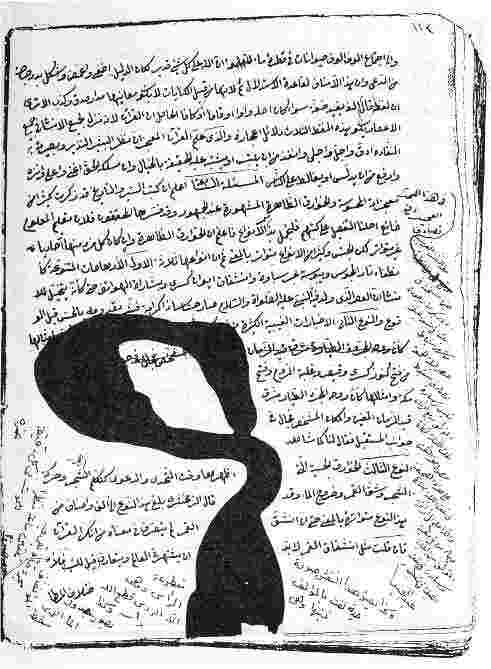
The Third Category: Wonders that could be perceived by the physical senses and were performed during [the period of] his challenging [the existing order] and calling [to Islam]. [These included] stones speaking, trees moving, the splitting of the moon, and water flowing [from his fingers]. Al‑Zamakhsharī stated that there were as many as a thousand [miracles] of this category. Some of these have been reported unanimously but not literally (mutawātir bi’l‑ma‘nā). In fact, even those who denied the Qur’an could not tamper with the verse And the moon is split.
If You Were to Ask: Something like the splitting of the moon should have become world famous and known by everyone?
You Would Be Told: [Factors like] differences in the time of its rising, and the existence of cloud, and there being little observation of the skies at that time, and its occurrence at an hour [people are] inattentive, during the night, and its occurring instantaneously, all meant that it was not seen by everyone or most people. Nevertheless, it has been established in narrations that it was witnessed by many caravans for which the moon’s position was similar to that [of Mecca].
However, the chief of these miracles is the Perspicuous Qur’an whose proven miraculousness in seven aspects is indicated by this verse.
Friend! If you have understood these matters listen now to what you will be told about the three aspects of the verses’ positioning and ordering (naẓm): the verse’s positioning in relation to what preceded it; the positioning [and relationships] of some of its phrases; the positioning [and relationships] of the parts of the phrases. Concerning the First: There Are Two Aspects to the Relationship of This Verse and the Preceding Ones. The First:
According to Ibn ‘Abbas’ commentary, when in order to prove divine unity [the Qur’an] says: O you people! (Yā ayyuhā an‑nās), it also proves the prophethood of Muhammad (Upon whom be blessings and peace), who was the clearest proof of divine unity.
Now, prophethood is proven by miracles. And the greatest of miracles is the Qur’an. And the most subtle facet of the Qur’an’s miraculousness lies in the eloquence of its composition (naẓm). Muslims agree that the Qur’an is miraculous and inimitable.
The authoritative scholars however differ as to the ways in which this is so. Nevertheless, these ways do not conflict, for some prefer one aspect [and others another aspect].
Aspects of Qur’an’s Miraculousness
Some say that its inimitability lies in its relating facts about the unseen realms (ikhbāruhu bi’l‑ghuyūb); according to others, it is its bringing together [all] truths and sciences;
others assert it is its freedom from contradictions and inconsistencies;
according to others, it is the originality of its styles and the singularity of the beginnings and ends of its verses and suras;
others say it was its appearance from someone illiterate who could neither read nor write;
according to others it was its composition being so extraordinarily eloquent as to be beyond human power; and so on and so forth.
Detailed knowledge of this [latter] sort of miraculousness may be obtained by studying Qur’anic commentaries such as the present work,
or it may be learnt summarily in [the following] three ways, as it was ascertained by ‘Abd al‑Qāhir al-Jurjānī, the Master of Eloquence (al‑Shaykh al-Balāgha), and al‑Zamakhsharī, and al-Sakkākī, and al-Jāḥiẓ:
The First Way: The Arab people were illiterate nomads [who lived] in an unusual environment that suited them. They were awaked by the mighty revolutions [occurring] in the world. Their [only] books (dīwānuhum) [of their proud exploits consisted of] poetry and their [only] science was rhetoric (al‑balāgha), and [the source] of their pride and vainglory was eloquent speech (al‑faṣāḥa) in such fairs as ‘Ukāẓ. They were the cleverest of peoples and therefore the most needy for mental exercise and activity, and mentally they were experiencing a period of burgeoning youth.
Then the Holy Qur’an rose upon them with its majesterial eloquence and outshone their eloquence, represented by the Seven Hanging Odes (al‑mu‘allaqāt al- sab‘a), inscribed in gold [hanging] on the walls of the Ka‘ba.
Despite their being eloquent orators – the commanders of rhetoric and eloquence and rulers of correct Arabic – they could not dispute the Qur’an nor utter a single word in argument, despite the severe taunts of the Messenger (UWBP) and his rebuking and chiding them, and discrediting their intelligence, and provoking them over a long period, and his humiliating them although some of their orators’ heads touched the skies in their pride and others reached the stars.
So if they had not wanted to dispute [the Qur’an] and put it to the test and if they had not been aware of their impotence, they surely would not have remained silent. Their total inability [to dispute the Qur’an] was therefore proof of its miraculousness and inimitability.
The Second Way: Punctillious scholars and critics with knowledge of all the parts of speech and their properties and fine points, have studied the Qur’an sura by sura, passage by passage, verse by verse, and word by word, and they have testified that it brings together truths, qualities, and subtleties not found all together in human speech. There are thousands of such [scholars].
Evidence for the veracity of their testimony are the momentous changes that the Qur’an wrought in the world of humanity, and the widespread religion it founded, and its perpetuating down the ages what it contains of the sciences, and its growing younger as time grows older, and its becoming sweeter the more it is repeated. Hence It is only revelation inspired.
The Third Way: As is pointed out by al‑Jāḥiẓ, despite the intense need of the masters of oratory and rhetoric to invalidate and frustrate the Messenger’s (Upon whom be peace) cause, and in spite of their hatred of him and obduracy, they gave up disputing him verbally, which was the safest, easiest, and most direct way, and they took up arms against him, despite this being the most difficult and lengthy way, beset with dangers and of uncertain end. Moreover, their political acumen was such that the differences between these two ways could not have escaped them.
So the person who avoided the first way although it was possible [to attempt it] and would have been more effective at thwarting the [Messenger’s] cause, and took the way that threw his property and life into peril, must have been either stupid – and this could not be ascribed to those who ruled the world after they were rightly‑guided – or he felt powerless to take the former way and was compelled to take the latter.
If You Were to Ask: It was possible to dispute [the Qur’an], but perhaps for some reason or other it was not attempted?
You Would Be Told: If it had been possible some people would have striven to do so since the provocations were [severe] and the need was intense. And if they had disputed it, it would have been known, for it was much sought after and there were many reasons for its being known. And if it had become known, there would have been many who supported [such an attempt to dispute it], and to defend it, and they would have said that it had been disputed, particularly at that time. And had there been opposers and defenders, even if only out of bigotry, it would have become famous, for it was a matter of great import. And if it had been famous, it would have been reported in the chronicles, just as they reported the ravings of Musaylima [the Liar] when he said [in imitation of the Qur’an]: “An elephant, what is an elephant? How can you recognize an elephant? It has a short tail and long trunk.”
If You Were to Ask: Musaylima was an eloquent orator, so how is it that his words have been so mocked and scorned by people?
You Would Be Told: Because he was [his words were] compared with something far higher than himself. Haven’t you noticed that if someone is compared with Yūsuf (Joseph) (Upon whom be peace), he appears ugly even though he may be good looking? It is therefore not possible to dispute the Qur’an, so it must be miraculous.
If You Were to Ask: The sceptics have voiced many objections and doubts on grammatical grounds about the Qur’an’s phrases and words, such as, in hādhān – these two, al‑ṣābi‘ūna – Sabeans, and alladhī istawqaḍa nāran – who kindle a fire?
You Would Be Told: You should consult the conclusion of al‑Sakkākī’s Miftāḥ, for he effectively silences [such objectors] saying: “Don’t they understand that a person whose eloquently correct speech is unanimously acknowledged would know whether or not what he had repeatedly stated over a long period of time contained the errors noticed by unthinking people like them?”
The Second Aspect of the Verse’s Positioning [and Relationship with the Previous Verses]
When the previous verse commands worship, the listener asks in his mind: “How should we worship?” And it as though answers: “As the Qur’an teaches you!”
So then the person asks: “How can we know that it’s the word of Allah the Most High?”
And it replies saying: And if you are in doubt as to what We have revealed, step by step, to Our servant.‥
The positioning of the verse’s phrases:
The sentence And if you are in doubt as to what We have revealed, step by step, to Our servant (Wa in kuntum fī raybin mimmā nazzalnā ‘alā ‘abdinā) has fallen into place most aptly,
for when the Qur’an commands worship, it is as though it is asked: “How can we know that it’s Allah’s command, that we have to comply with it?” And it replies: “If you doubt it, try [to produce something similar] yourself; then you’ll be certain that it’s Allah’s command.”
Another aspect of the verse’s positioning is this: the Qur’an, having praised itself with the sentence concerning which is no doubt, guidance sure for those who fear Allah, and followed this with praise of the believers, and having gone on from this to censure the disbelievers and dissemblers and then proceeded to command worship and the affirmation of divine unity, it now returns to the beginning and directs attention to concerning which is no doubt. That is, no doubts can be levelled at the Qur’an; if you have doubts, they arise from your diseased hearts and sickly characters. One denied the sunlight due to disease of the eyes, And felt disgust at the taste of water due to sickness.
The positioning of the phrase: then produce a Sura like thereunto (fa‑’tū bi-sūratin min mithlihi):
This is the apodosis [of the protasis (condition) if you are in doubt], and the apodosis has to be the consequence of the conditional verb. And since the command [then produce a Sura…] is provocative (ta‘jīzī), it necessitates the implied command make the attempt to! (tashabbathū). And since the command expresses something new (inshā’), and this cannot be a consequence, the consequence of the command has to be something other than the apodosis. And this is the necessity that is one of the basic meanings of the command. Now, the necessity of attempting also does not appear to be the consequence of their doubting, so this requires implied sentences concealed beneath the verse. The implied sentences are these: “If you doubt that this is Allah’s word, you should study its miraculous nature, for something miraculous cannot be human and Muhammad (Upon whom be blessings and peace) is human. If you want its miraculousness to be evident, try yourself [to produce something similar] and that you’re incapable will become clear. That means you are obliged to attempt to produce a sura similar to it.”
and call your witnesses [and helpers if there are any] besides Allah (wa’d‘ū shuhadā’akum min dūn Allāh),
It Has Three Aspects:
The First:
They say: “Just because we are incapable [of producing its like] it does not prove that all mankind is incapable.” So it dumbfounds them with the words: and call your witnesses [and helpers if there are any] besides Allah; that is, your elders and leaders.
The Second:
They declare: “If we dispute [the Qur’an], who would support us and defend us?” So it silences them saying: “Whatever the outlook, it has its adherents. Were you to dispute it, supporters would emerge to defend you.”
The Third:
It is as though the Qur’an is saying: “The Messenger (Upon whom be peace) calls on Allah the Most High as witness, and Allah testifies to his truthfulness by placing the stamp of miraculousness on his cause. So if your gods and witnesses are any use to you at all, call on them!” In this way, [the Qur’an] pours scorn on them.
The positioning and relationship of But if you cannot (Fa‑in lam taf‘alū) is clear.
For it implies the following phrases: “So attempt it, but look! [You can’t!] And if you can’t, it’s clear you’re incapable of doing it!”
The positioning of and of a surety you cannot (wa lan taf‘alū): It is as if when it says of a surety you cannot, one of them says in reply: “Just because we haven’t been able to do it, it doesn’t mean mankind will be incapable of doing it in the future.” So it replies: “of a surety you cannot (lit. will not).” This Signifies Its Miraculousness in Three Respects:
The First:
Its foretelling the future, and as it predicted so it was. As you know, millions of Arabic books have attempted to imitate the style of Revelation, as well as numerous obdurate [deniers], yet none of them has been successful, as you will see if you scrutinize them. It is as though it is the single one of its kind. So it is either inferior to all of them, and this is unanimously agreed to be impossible, or it is superior.
The Second Respect:
Its silencing and snubbing them, and censuring them for not doing it, and provoking them, while [the Messenger] was in that precarious situation [furthering] his great cause. This is a sure sign that he was reliable, trustworthy, and confident in his message.
The Third Respect:
It is as though the Qur’an is saying: “You’re the leaders in eloquent speech and the ones most needy [to produce the like of the Qur’an], yet you haven’t been able to, so no one else will!”
Moreover, it infers that just as the past could not produce anything similar to Islam, the result of the Qur’an, so will the future will incapable of producing anything similar.
Now the positioning of then fear the Fire whose fuel is men and stones, which is prepared for those who reject faith (fa‑’ttaqū al-nār allatī waqūduhā an-nās wa al-ḥijāra):
Consider this: if you cannot being followed by then fear necessitates according to the tastes of eloquence the following implied sentences:
“Since you haven’t been able to do it and you won’t be able to, it’s obvious it’s miraculous,
so it [must be] Allah’s word.
Hence it is incumbent on you to believe in it and comply with its commands.
And one of its commands is ‘O you people! Worship!,’
that you may fear Hell‑fire, so fear the Fire!”
See how concise it is, how miraculous!
The positioning of whose fuel is men and stones (allatī waqūduhā al‑nās wa al-ḥijāra):
The purpose of then fear (fa‑’ttaqū) is to frighten, and [here, being followed by the Fire] it has a strengthened, intensified meaning, in order to terrify them with whose fuel is men. For a fire fuelled by human beings is more appalling and horrifying. Then it further intensifies it by adding stones. For [the fire] that burns stones is even fiercer.
It also infers that it is restraining them from idolatry. That is, if you don’t comply with Allah’s command and you worship stone idols, you will enter the Fire that consumes both worshippers and their objects of worship.
The positioning of prepared for those who reject faith (u‘iddat li’l‑kāfirīn): This elucidates and establishes the consequence (luzūm) between the conditional verb if you cannot [the protasis] and its apodosis then fear. That is, this calamity is not like storm and tempest and other [natural] disasters which do not strike wrongdoers alone but encompass the righteous and elect; it is particular to offenders and caused by disbelief, and the only means of salvation from it is to comply with the Qur’an.
Moreover, prepared (u‘iddat) indicates that Hell is created and existent at the present moment, contrarily to what the Mu‘tazilites asserted.
The following will show you, and allow you to surmise, that Hell is eternal: if you reflect on the world from the point of view of wisdom (al‑ḥikma), you will see fire to be a vast creature, prevailing and overwhelming, a primordial element of the lofty and lower worlds. And you will understand that it consists of a huge head and strange fruits that hang over into eternity. Don’t you see that someone who espies a long stalk trailing along [the ground] will understand there to be a melon at the end of it; similarly whoever sees the creatures of fire will understand that at their extremity are the bitter fruits of Hell. Likewise, whoever sees bounties and good things and pleasures will surmise that their extracts and the place they are poured out and their garden is Paradise.
If You Were to Ask: If Hell exists now, where is it located?
You Would Be Told: We Sunnis believe that it exists now, but we cannot specify where.
And If You Were to Ask: The literal meanings of some Hadiths indicate that it is under the earth, and in one it says that its fire is two hundred times fiercer and hotter than worldly fire, and that the sun also will enter Hell?
You Would Be Told: The expression “under the earth” means its core, for the centre is under the globe. It has been established by scientific theories that the heat (lit. fire) at the [earth’s] centre reaches two hundred thousand degrees. For every thirty‑three commercial cubits (dhirā’ al‑tujjār) one digs down into the earth, the temperature increases one degree, and at the centre it is approximately two hundred thousand degrees. This theory is in conformity with the Hadith that says that it is two hundred times hotter than worldly fire.
Moreover, in another Hadith it says that a part of this fire [of Hell] is freezing (zamharīr) and that it burns with its coldness. This corresponds to the theory, for the fire at the centre – [from the centre] to the surface – comprises all degrees of fire [heat]. And it has been established by natural science [al‑ḥikmat al-ṭabī‘iyya] that there is a degree of heat (lit. fire) that spontaneously attracts surrounding heat and burns it with its coldness and freezes water.
If You Were to Ask: The fire inside the earth, that it contains, is very small, so how will it encompass Hell, which will encompass the heavens and earth?
You Would Be Told: Even if in respect of this manifest world (al‑mulk) and [Hell] being ‘rolled up’ (al‑maṭwīyya), it is contained by the earth, but in respect of the hereafter, it will become so vast it will encompass thousands [of globes] similar to the earth. Yes, the Manifest World (‘ālam al‑shahāda) is like a screen preventing contact between this [present] fire and its branches.
Also, its being under the earth does not necessitate its being conjoined with it, for the branches of the tree of creation have produced such fruits as the sun, the moon, and the stars, and our earth, and other earths. So what lies beneath the fruits includes the area between the branches where it is found. The dominions (mulk) of Allah the Most High are indeed wide and the tree of creation is spread [throughout them], so wherever Hell travels it cannot be repulsed.
It says in a Hadith: “Hell is folded up.” This possibly means that Hell is an egg of the bird of our flying earth, and when the veil of the Manifest World is rent, [the earth] will lay its egg and [Hell] will emerge, baring its teeth at the people of rebellion.
It is also possible that it was this [question of Hell] being ‘folded up’ that caused the Mu‘tazilites to fall into the error [of believing] that Hell is not now existent, and to cling onto it.
Now for the positioning [and relationships of] the parts of the phrases:
The [conjunction] and (al‑wāw) in And if you are in doubt as to what We have revealed, step by step, to Our servant (Wa in kuntum fī raybin mimmā nazzalnā ‘alā ‘abdina), is [so placed] because of the relationship between [this verse and O you people! Worship…, but no such relationship is apparent. It becomes apparent only through two implied questions and their answers:
Firstly is the implied answer to the question arising from the first verse: “How should we worship?”, that is,] “as the Qur’an has taught you.” [In reply to the second implied question: “How can we know the Qur’an is Allah’s word?”, it says: And if you are in doubt…]
The use of if (in), which expresses hesitation, instead of idhā, which infers certainty and resolve,
[although it is certain that they are in a state of doubt,] indicates that because means had arisen to dispel their doubts, their very existence should be doubtful or impossible even; they could only be hypothetical.
Also, the doubt expressed by if (in) looks to the [literary] style and not to the Speaker (May He be exalted).
The substitution of if you are in doubt (in kuntum fī raybin)" for [the verbal form] ‘you doubt’ although the latter is more concise, indicates that the source of their doubt is their sick natures and characters.
And the doubt encompassing (ẓarfīyya) them although it is contained (maẓrūf) by their hearts
hints that the darkness of doubt has spread from their hearts and overwhelmed their whole physical beings, enveloping in darkness all ways [of possible illumination].
The use of the indefinite for doubt (rayb) is to make it general. That is, whichever of the sorts of doubt you feel, the answer is the same, and that is: [the Qur’an] is miraculous and true! Thus, your accusing [the Qur’an] of error due to your superficial view is an error and it is not necessary to answer every doubt specifically. You can surely see that a person who [happens upon] a spring and tastes its pure, sweet water does not need to taste all its subsidiary streams and branches.
The [partitive] min in mimmā – as to (lit. a part of) infers the implied words about a part of what of We have revealed (fī shay’in mimmā).
The word(s) we have revealed (nazzalnā) indicates that the source of their doubt is [the Qur’an’s] revelation (lit. descent). And the decisive reply proves its revelation.
The choice of [the IInd form] nazzalnā, which denotes gradual revelation, instead of [the IVth form] anzalnā, which suggests that it was sudden, alludes to the excuses they advanced saying: “Why isn’t it revealed to him all at once?” Indeed, the Qur’an was revealed gradually as events required, according to circumstances, verse‑by-verse, sura-by-sura.
The choice of the word ‘servant [or bondsman] (‘abd)’ rather than ‘the Messenger’ or ‘Muhammad’ indicates exaltation of the Messenger, and hints at the elevated nature of worship, and corroborates the command Worship!, and infers the repulsion of delusions, for the Messenger (Upon whom be peace) performed more worship than anyone and recited more of the Qur’an. So reflect on this!
The phrase then produce a sura like thereunto (fa‑’tū bi-sūratin min mithlihi): [The purpose of] the command then produce is to display their impotence, and it comprises a challenge, and censure, and calls on them to try to dispute it, making clear their inability to do this.
While the word a sura indicates [the Qur’an’s] silencing and dumbfounding them utterly, as follows:
The First Level of Challenge: It says: “Produce the like of the whole Qur’an together with its truths, sciences, predictions, and elevated composition, all from someone illiterate.
The Second Level: It says: “If you can’t do that, fabricate something, but its composition must be similarly eloquent.
The Third Level: It says: “If you can’t do that either, produce around ten suras.
The Fourth Level: If you’re not capable of doing that either, just produce [the equivalent of] a long sura.
The Fifth Level: If that’s too difficult for you as well, just bring one sura even if it’s very short like Behold We have bestowed upon thee (Innā a‘ṭaināka), and from someone illiterate like him.
The Sixth Level: If it isn’t possible for you to have it produced by someone illiterate, get an adept scholar or skilful writer to do it.
The Seventh Level: If that’s too hard for you too, a number of you co‑operate to produce it.
The Eighth Level: And if you can’t do that, seek the help of all men and jinn, and the assistance of all the results of their shared knowledge from the time of Adam till the end of the world, as well as those ideas found in the books available to you about the Arabic language and its styles, written with the desire to imitate [the Qur’an] or out of obstinacy by those wanting to dispute it. To say nothing of authoritative scholars, if a person of scant intelligence or an ignorant one even were to study them, he would declare that none of them was similar to [the Qur’an]. So it is either inferior to all of them, and this is impossible as is unanimously agreed, or it is superior to all. And this is what was wanted, as was mentioned above. Indeed, it has not been [successfully] disputed in thirteen centuries. And as that was true in the past, so it will be in the future, till the end of time.
The Ninth Level: It says: Don’t remonstrate saying you don’t have any witnesses and we don’t testify for you either. Go and call your witnesses and your partisans and let them consult their consciences; will they be so bold as to uphold what you claim disputing [the Qur’an]?
If you have understood these levels, consider now how the Qur’an is miraculous in its conciseness, indicating these levels, silencing them effectively and loosening their bridles [giving them the opportunity to reply].
Understand too that human incapability to dispute even the shortest sura is a clear argument from effect to cause (innīyatuhu badīhīyya).
As for its being argued from cause to effect (limmīyyatuhu), it is said “Allah the Most High prevented men from disputing it.” The most correct school in the latter question [the argument from cause to effect] is that followed by ‘Abd al‑Qāhir al-Jurjānī, al-Zamakhsharī, and al-Sakkākī. This states that “it is beyond human power [to emulate the Qur’an’s] elevated composition.”
Moreover, al‑Sakkākī preferred [the view] that its miraculous inimitability can only be sensed (dhawqī) and cannot be expressed or explicated. It can only be experienced.”
But the author of Dalā’il al‑I‘jāz [al‑Jurjānī] preferred [the view] that it is possible to express it [in words], and we subscribe to his school in this question.
The choice of “sūra” rather than such words as najm, ṭā’ifa, or nawba,
indicates [the Qur’an’s] silencing them [by answering] the source of their doubts, namely,
“Why wasn’t it revealed to him all at once?” That is, [the Qur’an told them:] “You produce some and let’s see it, even if only a single short piece!”
The choice of the word sūra signifies too that there are numerous benefits in the Qur’an being divided into suras, as has been elucidated by al‑Zamakhsharī, and that this unusual method contains many subtle points.
The phrase like thereunto (min mithlihi) signifies two [possible] things: That is, [the suffixed pronoun hi refers] either to the thing revealed (al‑munzal) [the Qur’an – that is, “produce a sura like one of the Qur‘an’s”], or to the one to whom it was revealed (al‑munzal ‘alayhi) [the Messenger – that is, “get someone unlettered like him to produce it”]. If it is the former, it should be phrased mithli sūratin minhu, but it is expressed as min mithlihi,
indicating that the second possibility is taken into account. That is, “You can invalidate his case with your disputing only if someone unlettered like him [the Messenger] does it.”
It indicates too that [the Qur’an’s] miraculousness could be invalidated only if disputed by a collection [a literary work, majmū‘a – that is, if the sura produced was part of a complete work] like [the Qur’an].
The phrase also allusively directs attention to the other scriptures that were revealed like the Qur’an, so that the listener may weigh them up in his mind and understand the Qur’an’s elevated nature.
The sentence and call your witnesses [and helpers if there are any] besides Allah (wa’d‘ū shuhadā’akum min dūn Allāh): The choice of and call (wa’d‘ū) instead of ‘seek the help or assistance of’ indicates that those who might respond to them and defend them are not non‑existent but are there [with them] and do not need to be called.
The word witnesses (shuhadā’) comprises three meanings: your authorities on the Arabic language, those who observe [witness] you, and your gods.
In Respect of the First it silences them by rebutting their argument that their own inability does not prove that their literary leaders lack the power [to imitate the Qur’an].
In Respect of the Second it dumbfounds them by cutting short their excuse that they had no witnesses, for every outlook and way has defenders and witnesses.
In Respect of the Third it rebukes and derides them, asking why their gods, which they look to for benefits and to repel harm, do not help them in this matter that is troubling them.
The genitive construction of witnesses and the pronominal suffix “your (‑kum)” denotes particularity and strengthens the first meaning [above]:
“Your great ones are present with you and there are special [bonds] between you; if they had been capable of helping you, surely [they would have done].”
It expresses the second meaning like this: “We accept the testimony of those who support you and are your partisans, for they won’t venture to testify for something whose invalidity is self‑evident.”
And it takes the third meaning by the arm and mocks it, saying: “Why don’t the gods you worship help you?”
With respect to the first, the phrase besides Allah (min dūn Allāh) indicates generality; that is, [call] all the eloquent masters of language in the world other than Allah the Most High. It indicates too that [the Qur’an’s] miraculousness is only [miraculousness] because it is from Allah. With respect to the second, it indicates their impotence and confusion when they say: “Allah is our witness. Allah knows that we can do it.” For it is the habit of those defeated in argument and reduced to impotence to swear by Allah and call on Him to witness what they are incapable of proving. And with respect to the third it indicates that their disputing the Messenger (Upon whom be blessings and peace) was exactly the response of associating partners with Allah (shirk) to divine unity (tawḥīd), and of lifeless, unconscious beings to the Creator of the heavens and the earth.
The phrase if what you say is true (in kuntum ṣādiqīn) alludes to their saying: “If we wanted, we could say something similar.”
It also insinuates: “You aren’t truthful. Your truthfulness is only hypothetical; indeed, you only utter sophistries. And you haven’t fallen into doubt because you were seeking the truth, but because you were seeking the false, and you fell into it.
Furthermore, the consequence (apodosis) [of the conditional verb “if what you say”] is the sum and substance of the previous phrases; that is, “do it!”
That is, If what you say is true, then try to produce something similar.
The sentence: But if you cannot, and of a surety you cannot, then fear the Fire (Fa‑in lam taf‘alū wa lan taf‘alū fa-’ttaqū al-nār)
With the phrase “If what you say is true” the Qur’an is confuting them with a conditional syllogism, excepting the opposite of the following phrase to occasion the opposite of the preceding one.
A summary of it: “If you were truthful, you would have disputed it and produced a sura, but you didn’t [coundn’t] and you won’t [be able to]. One concludes from this that you weren’t truthful, while your enemy, the Messenger (Upon whom be peace), is truthful and that the Qur’an is miraculous. So this obliges you to believe in him so that you may fear [avoid] the punishment [of the Fire]!”
which is then fear the Fire (fa‑’ttaqū al-nār), to frighten, intimidate, and threaten them.
As for if you cannot (lit. have not) (in lam taf‘alū): Its signifying the past by virtue of the lam – not and the future through the if (in) is in order to direct attention towards their past, as though it is saying to them: “Look at your decorated orations and gilded Seven Hanging Odes: are any of them equal to [the Qur’an] or close to it even, or in the same class?”
The choice of do, make (taf‘alū) rather than bring (ta’tū) suggests two points:
The First: It infers that the source of the [Qur’an’s] miraculousness and inimitability (i‘jāz) is their impotence (‘ajz), and the source of their impotence is [related to] action (fi‘l) not to the work (athar). [That is, the source of their impotence is their inability to ‘do’ or produce something similar to the Qur’an, not the work itself].
The Second: It is for conciseness. For just as in grammar [the verbal root] fa‘ala is used to depict the patterns and forms of the verb, so in the literary styles it is used as the summary of actions and stories, as though it were a pronoun expressing whole sentences and a metonymy (kināya) for them.
And of a surety you cannot (wa lan taf‘alū): The future and emphasis expressed by lan infer definiteness, and this indicates that the speaker is confident and serious and that he has no doubts concerning what he is saying. And this is a sign that there is no trickery or deception [in what he says and does].
The use of then fear (fa‑’ttaqū) instead of avoid (tajannabū), [both express the same meaning, but al‑ittiqā’ follows on after belief, while avoidance does not have this secondary meaning]
implies as a substitute for the consequence [of the above conditional sentence] the sentence: “Believe and avoid associating partners with Allah (shirk), which is a cause of entering Hell‑fire.”
The definite article is used in the Fire (al‑nār) because it is well known and firmly fixed in people’s minds, having been heard about from [all] the prophets from Adam up till now.
Its being governed by the relative pronoun which (allatī) although [such pronouns] generally refer to something previously known,
is in consequence of the earlier revelation of a Fire whose fuel is men and stones, before this verse, and those addressed had heard this. Thus, the relative pronoun is in place.
Whose fuel is men and stones (waqūduhā al‑nās wa’l-ḥijāra): As mentioned above, the purpose of this is to intimidate, and intimidation is made severer by threatening. Thus it threatens with the word “men” as though striking them and reinforces this with “stones” as though castigating them:
“What profit or salvation do you hope for from these idols that are now the instruments of your torture?”
As for the phrase: prepared for those who reject faith (u‘iddat li’l‑kāfirīn): Know that the position [here required] ‘prepared for you (la‑kum)’,
however, generally the Qur’an mentions summaries and general rules at the ends of verses to indicate the most powerful evidences for the statements [made in the verse in question].
Thus, what is basically [implied here] is
prepared for you if you disbelieve, since it is prepared for the disbelievers. For this reason the noun is used in place of the pronoun.